What exactly are DELF and DALF, and how do they differ?
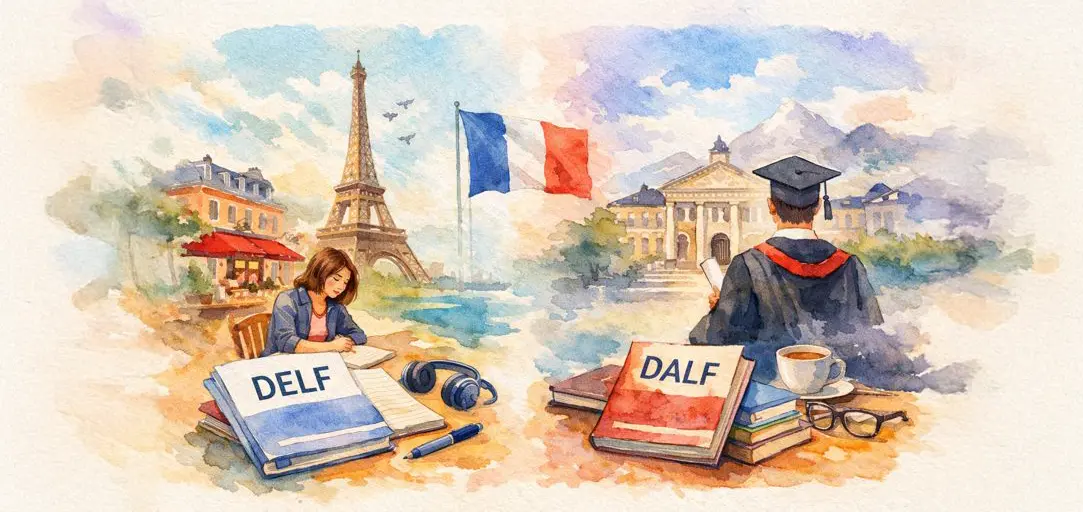
In short: DELF certifies language skills from A1 to B2 and is suitable for learners from beginner to upper intermediate level. DALF covers levels C1 and C2 and is aimed at people with near-native proficiency. Choose DELF if you want to improve your everyday or professional communication skills, and DALF if you are aiming to study or work in a demanding role in a French-speaking environment.
What is DELF?
DELF stands for "Diplôme d'Études en Langue Française" and covers the four CEFR levels A1, A2, B1, and B2. These levels are based on the Common European Framework of Reference for Languages and represent a clear progression in learning.
The DELF/DALF exam at DELF level is ideal for anyone who wants to officially certify their basic to advanced French language skills. This can be relevant for studying, working, or simply as internationally recognized proof of your language proficiency.
Four skills are tested at each level: listening comprehension, reading comprehension, writing, and speaking. With a DELF B2 certificate, for example, you already meet the language requirements of many French universities without having to take an additional language test. This level is therefore particularly attractive for prospective students.
What is DALF?
DALF stands for "Diplôme Approfondi de Langue Française" and certifies language skills at the highest CEFR levels C1 and C2. These diplomas show that you have mastered French at a very advanced level.
A DELF/DALF test at DALF level is particularly recommended for anyone who wants to study at a French university, as a minimum of C1 is often required. DALF is also a clear advantage in professions with high language requirements. With DALF C2, you will reach the highest official level and prove that you have a confident command of the French language, even in complex academic and professional situations.

DELF vs. DALF: The most important differences
The key difference between DELF and DALF lies in the language level required. DELF is aimed at learners who want to systematically build or consolidate their language skills, while DALF is designed for very advanced speakers.
The level of difficulty of the exam tasks also differs significantly. For DELF B2, you write structured texts on familiar topics, while DALF C1 requires you to be able to express complex content in a differentiated, argumentative, and stylistically confident manner. The topics become more abstract, the texts more extensive, and linguistic accuracy plays a much greater role.
DELF and DALF Switzerland are particularly relevant, as multilingualism plays a central role in Switzerland and French is a professional advantage in many cantons. Both diplomas are recognized nationwide and can significantly improve your chances on the job market or in your studies.
Which degree is right for you?
The choice depends primarily on your personal goals. If you want to work in a French-speaking environment, DELF B2 or DALF C1 are often required. If you are planning to study, you should carefully check the language requirements of your desired university, as many programs require at least B2, but some require C1.
If you are just starting out or want to refresh your basics, DELF A1 or A2 is a good place to start. These levels provide a solid foundation and allow you to clearly see your progress. The step-by-step structure ensures motivation and confidence in using the language.
How we prepare you for the exam at ILS-Exams
At ILS Exams, we offer a wide range of preparation courses that can be flexibly adapted to your goals and schedule. Whether you need a compact crash course, individual private lessons or structured group course, you will find the right format with us.
Our experienced teachers are familiar with the DELF/DALF exam in detail and will prepare you specifically for all four areas of the exam. You will work with authentic practice materials, receive personal feedback, and go into the exam optimally prepared and feeling confident.